

My 2025 Year in Review: Ten years in

A neat little mall space in Brussels

My business and my book, Fearless Salary Negotiation, both turned 10 this year. This is my 11th annual Year In Review, and my first was My 2015 Year in Review: Using the stair-step approach.

I feel sort of at a loss as to what to say about that. Ten years feels simultaneously like such a long time and like no time at all. I’m really glad I have written these Year in Review posts every year because so much of it seems like a blur. It’s interesting to look back at the goals I set, which ones I hit, which ones I missed (most of them), and how they have changed over time.

My first Year in Review posts did not have forward-looking goals and only talked about goals I had set along the way while writing my book and working on other projects. Starting in 2016, I began to set annual goals and they were all business-focused. Those are pretty enlightening.

Over time I started incorporating a “Personal” section into my reviews and the relative “Personal” versus “Business” proportions have moved around over time.

In 2022, I only set one goal for 2023: “Survive to 2024”. And I did! A 100% success rate on 2023’s goals!

Now I’m writing about 2025 and it’s such a relief to say that this year was my second best revenue year ever. My best-ever year was 2021, and 2025’s revenue came in over 90% of 2021’s, which is pretty amazing because 2021 was off-the-charts good.

Personally, this was also a very good year. That is true in general, but of course having the business up and running again has eliminated a huge source of stress—rather than continuously watching my bank account shrink and wondering if my business would actually rebound, I am just sort of living life while I operate a business. The difference is night and day.

As ever, I focused a lot of time and energy on fitness-type stuff: pickleball, weightlifting, and yoga. Yoga has tapered to once a week, but weightlifting continues to be a three-days-a-week endeavor. I play pickleball as much as I can, but I also practice a lot via drilling or working with my Pickleball Tutor.

Ok, onto the detailed recap…

2025 Goal review

This year was hit-and-miss on the Goal front. I’m ok with that. I see my annual goals as a way to start the year off with something to focus on so I don’t start with a blank slate. My annual goals are less like train tracks and more like starting blocks.

I think last year’s goals were effective in this way. The misses are fine, and pursuing the goals was beneficial.

50% business growth

This was a stretch goal because I increased it by 50% in 2024, and I honestly didn’t think I would get all the way there this year. I actually exceeded this and ended around 70%.

I’m very happy with this and I hope it is a sign that my business is back up and running with my new and improved focus on high earners buoyed by a slow, steady transition to a luxury brand.

Build at least one new revenue stream

Miss. But that is mostly because I could sense that the business was coming back online at full force and that made additional revenue streams less urgent. Focusing on building the core business, which is the way I make my living, seemed prudent and still does in hindsight. Many of the revenue streams I had in mind last year also didn’t necessarily align with the luxury brand I have been building, so it just did not make sense to pursue them.

Improve to at least a 4.5 in pickleball

This was a pretty ambitious goal and I technically missed it: I’m not at 4.5 yet, but I’m around 4.25 or so.

Be more generous

It is interesting that this is so vague because I have found new ways to do this by both continuing things I already do and by adding new things. I’m not going to elaborate because it feels pretty self-serving, but in terms of evaluating this goal, I feel like it went pretty well.

Find one new go-to dish to cook

Miss. Well, technically I made a couple new things this year and they’re really good, but they were baked goods and not “dishes” per se. This goal was meant to be for an entree of some kind and I definitely missed on that.

This is fine. Cooking is time-consuming and I just chose to spend time elsewhere.

2025 Year in Review – Business
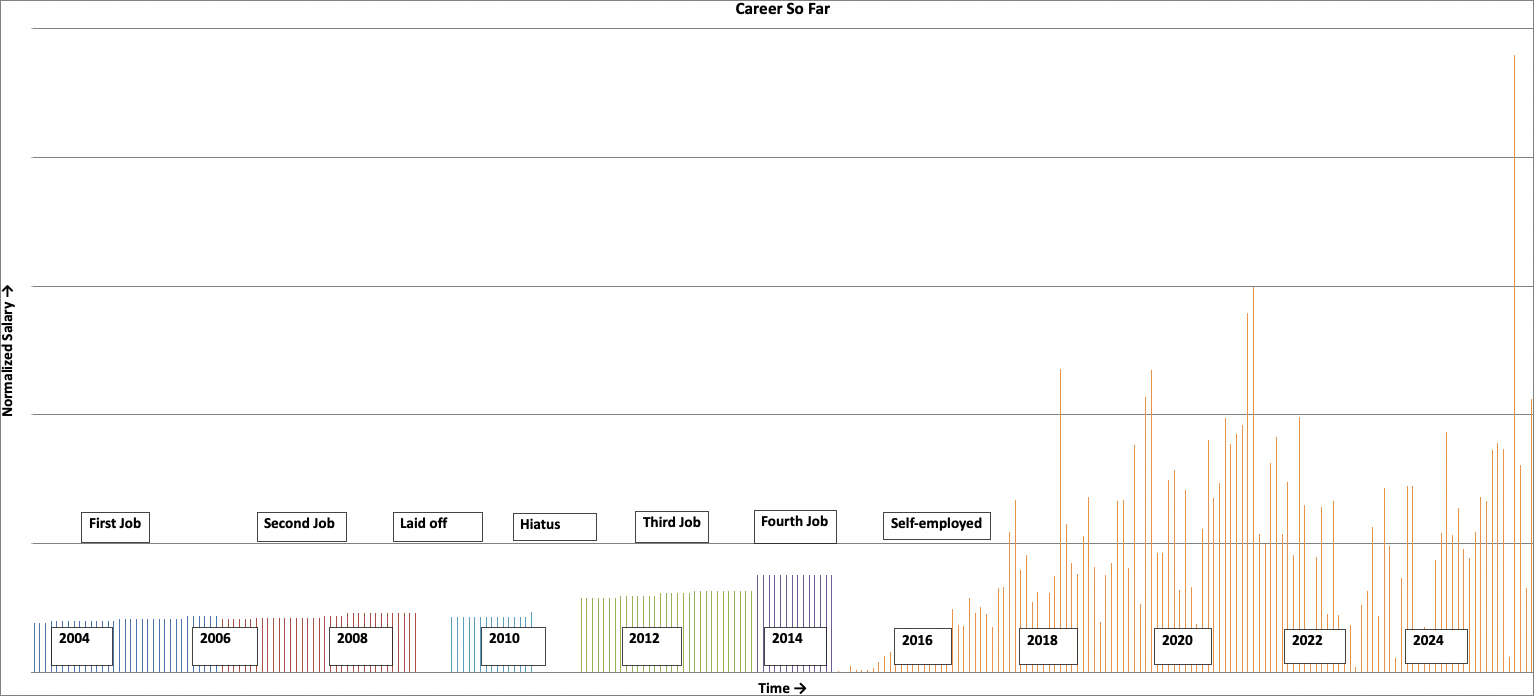
Career earnings to date through 2025

Well, that escalated quickly.

I felt like I was being a little optimistic with a 50% YoY growth goal, and I ended up around 70%. I set that goal around Christmas last year (2024) after a busier-than-expected December so I thought I may have been feeling optimistic. Nope—I actually under-shot.

This December was really busy as well. Not sure what’s going on there, but it seems like I might need to update my impression of the seasonality in my business to account for faster-paced Q4s.

I have learned to be cautious about extrapolating short-term results into long-term trends, so I’m withholding maximum optimism for at least one more year. But if 2026 is as good as (or better than) 2025? Safe to say the business is back and better than ever.

Stats

Here are the stats that I typically track:

  • Visits to FearlessSalaryNegotiation.com: 87,000 (down from a reported 160,000 in 2024)
  • Unique page views: About 140,000 (down from about 250,000)
  • Total email subscribers at the end of the year: About 22,000 (down from about 24,000)
  • Product sales through the site: About 25 (slightly up from 20)
  • Coaching applications: 95 (up from 80)
  • Coaching clients: 26 (up from about 17)
  • Coaching conversion rate (from prospect to client) was 27% (up from 21%)
  • Coaching revenue was up about 77% year over year.
  • Overall revenue was up 70% year over year.

For a long time, my business literally ran on SEO, but the bottom fell out alongside the Big Tech layoffs in 2022. Simultaneously, there was an influx of other companies creating content that crowded out my own content.

While it’s discouraging to seemingly lose something I worked so hard to build, the important thing to recognize is that the stats I really care about are the ones that are improving. Obviously, the one that matters most is overall revenue, which grew by 70%. And that follows from the increase in coaching clients and an increase in average revenue per client.

Yes, website traffic is down, my email list is smaller, and product sales are down, but those are essentially legacy stats that were much more important when I was running a higher-volume business. Early on in the business, I literally kept an eye on stats like “revenue per unique organic visitor”, “revenue per email subscriber”, and “modal time between email subscription and product purchase”.

As I have shifted to the luxury strategy, the stats have shifted to look more like a luxury business, namely “average revenue per client”. I like this stat because it also tracks directly with “average additional earnings for my clients”, which is the primary value proposition for my business.

Zooming out, my net revenue this year was almost 94% of what it was in 2021, which was my best year ever. But my coaching revenue this year was about 5% higher than it was in 2021 while product revenue and partnership revenue dropped off by quite a bit. That’s pretty much exactly what I would expect to see for a business transitioning from a higher-volume model with a mix of products and services to a luxury model that is laser-focused on high-end services.

I spent many years building up my SEO profile, and that served me well. Now I am building a luxury brand, which I believe will serve me better.

I also still get quite a bit of use from the SEO work I did because it turns out that LLMs like my content and I have booked clients via ChatGPT’s and other LLMs’ recommendations. I also have many more “returning client” and “referral” entries than I ever have before. It used to be that “Google” was almost always the source for new clients, and now there’s a much broader mix of things.

New “best month ever” mark

My previous best month happened in November 2021, breaking the record set in October 2021. September of this year is my new “best month ever”, exceeding October 2021 by about 60% and getting pretty darn close to matching the previous best two months combined. Some of that is just random timing—I happened to have my biggest result fee yet and that client decided to just pay everything in September—but timing is always a factor that affects monthly swings for the business. My worst month this year was August for the same reasons.

Pretty neat to go from “My business is struggling. Here’s my plan to save it.” two years ago to “New best month ever by 60%!” this year.

The fiduciary-ness of it all

Last year, I briefly mentioned that I had a very big negotiation that didn’t close when we were right at the finish line. I was pretty sure that was not because of anything I did, but just because the two parties were not going to find a mutually beneficial agreement.

Still, I couldn’t help but wonder: “Did I screw this up?” I was pretty sure there were a couple moments where I could have facilitated an agreement, but I did not think the available agreements aligned with my client’s priorities or were in my client’s best interests.

I am very lucky that I got to talk with that client recently (because he referred someone else to me) and he confirmed that he was extremely happy with the outcome and felt that everything we did was perfect and that the result was totally acceptable and even ideal.

I don’t always get such clear feedback on difficult situations, and I’m grateful that I got that feedback here.

My North Star is to do what’s best for my clients, behaving as ethically as possible. That doesn’t always lead to the best short-term result for my business, but I believe it will drive better long-term results.

The focus on high earners and executives is paying off

A couple years ago, I started to push hard to move my business to a luxury brand focused on helping high earners and executives.

The first big shift was to “high earners”, which I designated as folks making $400,000+. At the time, that felt like a pretty big risk: While I had worked with a number of people in that income range, I had mostly worked with people making less than $400,000.

“Are there really enough people making that kind of money who I can help?” That was my main concern, and it’s always a risk when niching down.

Turns out that yes, there are plenty of high earners and they’re eager to work with a professional salary negotiator. That shift was very slow and intentional, but it is absolutely working and it was the right move.

Slowly moving to luxury

I continue to make incremental changes to the business to shift more and more toward a luxury brand and experience. I’m going to unpack that a little bit for posterity, but also for those who might be curious what I’m up to.

One slow-burning change has been a continual simplification of pretty much everything. For example, the Fearless Salary Negotiation homepage used to be a longer-form page with lots of social proof, links to articles, product offerings, etc. Now it’s an extremely short page that is laser-focused on who I am, who I help, and how I help. There is a singular call to action: “Contact me today”.

That’s it. Very simple and direct. People who see that either think, “This is for me and I want to talk to Josh!” or they don’t. Most people—the vast majority of people—who see my homepage will probably decide that I am not the person they’re looking for. That’s by design and it seems to be working very well.

I have also drastically simplified my overall menu of offerings from my book, several other products, and a few variants on my services down to … well, down to basically one service: Salary Negotiation Coaching for High Earners. In 2025, I slowly pared back my website so that it’s harder and harder to find or buy products of any kind. Soon, I plan to just eliminate those options entirely and totally exit the product (or “info-product”) business.

The one exception is Salary Negotiation Mastery, which I still offer as an alternative to working with me for people who aren’t ready yet. Again, this is an example of simplifying and shortening. That sales page used to be a long-form info-product sales page and now it is not. I will probably tweak this over time, but I like the shorter, more focused page.

Here is how I would describe the higher-level meta strategy for this change: At first, I thought of my business exclusively as a high-volume product business. Then I added coaching. Then I flipped the overall concept to be a coaching business that also sold products. Those products and the coaching itself were essentially a “product ladder”, which would enable people to find a low-cost, high-value entry point (usually a free download) and use that to validate the value of my work. Eventually, those folks would hopefully buy a product, then possibly another product or a more expensive product. And sometimes those folks would hire me to coach them—the top of the product ladder.

Now, I see my business as a very specific, narrow offering of “Salary Negotiation Coaching for High Earners”. That’s it. I am the best at what I do, and I’ve helped hundreds of people significantly increase their earnings for over a decade now. For people who want to work with the best, I’m here to help. Once we talk, I’ll either recommend you work with me or that you don’t. For those who are good candidates for my service, but who aren’t quite ready to work with me, I offer Salary Negotiation Mastery.

Other shifts I’ve made over the past year or two to support this luxury focus are:

  • A simplified Negotiation Fee structure that is identical for everyone: $4,000 Strategy Component, 10% Improvement Component
  • I don’t collect any fees until after our work is complete
  • We start working when you sign my Letter of Engagement
  • There is no application or other barrier to talking to me—anyone can book a call with me to explore working together
  • You hired me to help you optimize your offer and de-stress the negotiation process, and that’s what I’ll do

I have now had several people say, “I looked at the options out there, and I know you’re more expensive, but I want to work with you because you’re the ‘executive comp’ guy.” That’s a very strong signal that I’m moving in the right direction.

Completing the shift from “Done With You” to “Done For You”

That last bullet point above is another important shift that I’m working on right now, and is worth elaborating on.

Everyone is familiar with “Do It Yourself” (AKA, DIY). There’s also “Done With You” (DWY) and “Done For You” (DFY). Those three are basically service tiers from “you’re on your own” to “everything done on your behalf”. In general, luxury brands are focused on “Done For You”, and they sometimes actively exclude any kind of DIY or DWY. In extreme cases, there is literally no customization or customer input at all—they either buy the product or service as-is, or they do not. That would sound something like, “We make 100 of these per year. They cost $100,000 each. If you would like one, then send us a deposit and we will put you on the list for the next available slot, which is in three years. The deposit is non-refundable. There is no customization, and there are no refunds or returns. Let us know if you would like to proceed.”

At first, my business was almost exclusively DIY (products). I say “almost exclusively” because I was available for email support and am sort of compulsive about helping people and replying to queries in my inbox, so I would still help people if they needed it, but mostly thought of my offering as DIY.

Then I started offering coaching, which I approached with a DWY mindset: I was the coach, which meant that I would try to get the best result, consult with clients along the way, and try to teach them how to do what I did so they would learn a new skill. This followed very nicely from all of my products, which were teaching them a new and valuable skill.

Over the past couple of years, as I have shifted more and more to a luxury offering, I have also shifted to a DFY approach. My clients interact with recruiters, CEOs, Hiring Managers, etc., but those interactions are more or less scripted by me for their benefit. I still collaborate with my clients because I need to know what they know, but I am more focused on de-stressing a difficult situation and getting them the best result than I am on teaching them how to negotiate on their own. I think the clients I was working with years ago wanted that—to learn how to negotiate—but I do not think the clients I work with now really care about that. They’re busy and not looking to learn a new skill; they just want to optimize their comp package before they sign on the dotted line.

This is one of the more challenging parts of this transition just because I like teaching people so much. I still do teach them things, but that is not my focus. This is a logical place to end up, though: Even thinking back on my first-ever coaching client—who had a copy of my book and whose spouse I had coached while I wrote my book—when I asked her why she hired me instead of just doing it herself, she said, “I just wanted you to tell me exactly what to do for my situation.” She did not say, “I wanted you to tell me what to do and teach me how to do it.” I did that on my own as a value-add while I grew the business. I think that feature just isn’t needed anymore, and might even be a detractor for people considering hiring me.

2025 Year in Review – Personal

What a great year! Obviously, the success of the business makes this easier, but that’s never a guarantee. In many ways, this year was more of the same, which is great.

Lille, France – My first vacation in a couple years

Thanks to the previously-reported business slump, I had not been on vacation in more than two years. This summer, I finally felt like I had enough margin (both time-wise and financial) to finally take a trip.

It helped that I had a bazillion unused Amex points, giving me lots of free flight options.

I have some friends who lead a study abroad program In Lille, France every summer, and they invite me to go hang out there every year. I finally took them up on it and joined them for about 10 days.

It was exactly the kind of vacation I like and just what I needed. I got an Airbnb right across from the Lille equivalent of Central Park, and spent a lot of time walking around the city and writing in the park. I wrote treatments for three book ideas I had been batting around and used ChatGPT to decide which project might be best to pursue. I narrowed it down to two projects, which are both promising in different ways.

I also ate some pretty good food and really enjoyed just hanging out in France where the sun set every night around 10:00 PM. I say “pretty good” food because the food was not what most people probably think of when they think “France” (because they’re probably thinking, “Paris”). Lille is way up in the north of France, very close to the Belgian border, so the food is very Flemish and heavy. That’s probably great in the winter, but really heavy Flemish stew with cheese-and-cream-forward dishes don’t hit the same when it’s 85 degrees outside and there’s no air conditioning to be found.

Still, the town was amazing and I got to go see a World War 1 cemetery and memorial in Belgium, which was awesome. I also spent a couple days in Brussels, where I enjoyed one of the best Italian meals I’ve ever had (sounds weird, but there just happened to be some Italian ex-pats who opened a restaurant there, and it was amazing).

Hopefully I’ll get at least a manuscript for one of those writing projects done this year, though I’m not sure this rises to the level of a goal for 2026. We’ll see.

While I’m here, a little easter egg for the few people who actually read these Year in Review posts. The two main book ideas I’m batting around are:

  • A book about building a luxury business for people who may not be at all familiar with luxury brands or how they work. There are a few good textbooks about luxury brands, but there aren’t really any modern how-to books. I think I could write a decent book on how to build a luxury business.
  • A book about how to be hospitable, specifically for introverts. That’s intentionally ambiguous as it would be about how an introvert can be hospitable, but also how to be hospitable to introverted people.

If either of those sounds particularly interesting to you, let me know. If neither sounds particularly interesting to you, let me know.

A neat little mall space in Brussels
A neat little mall space in Brussels

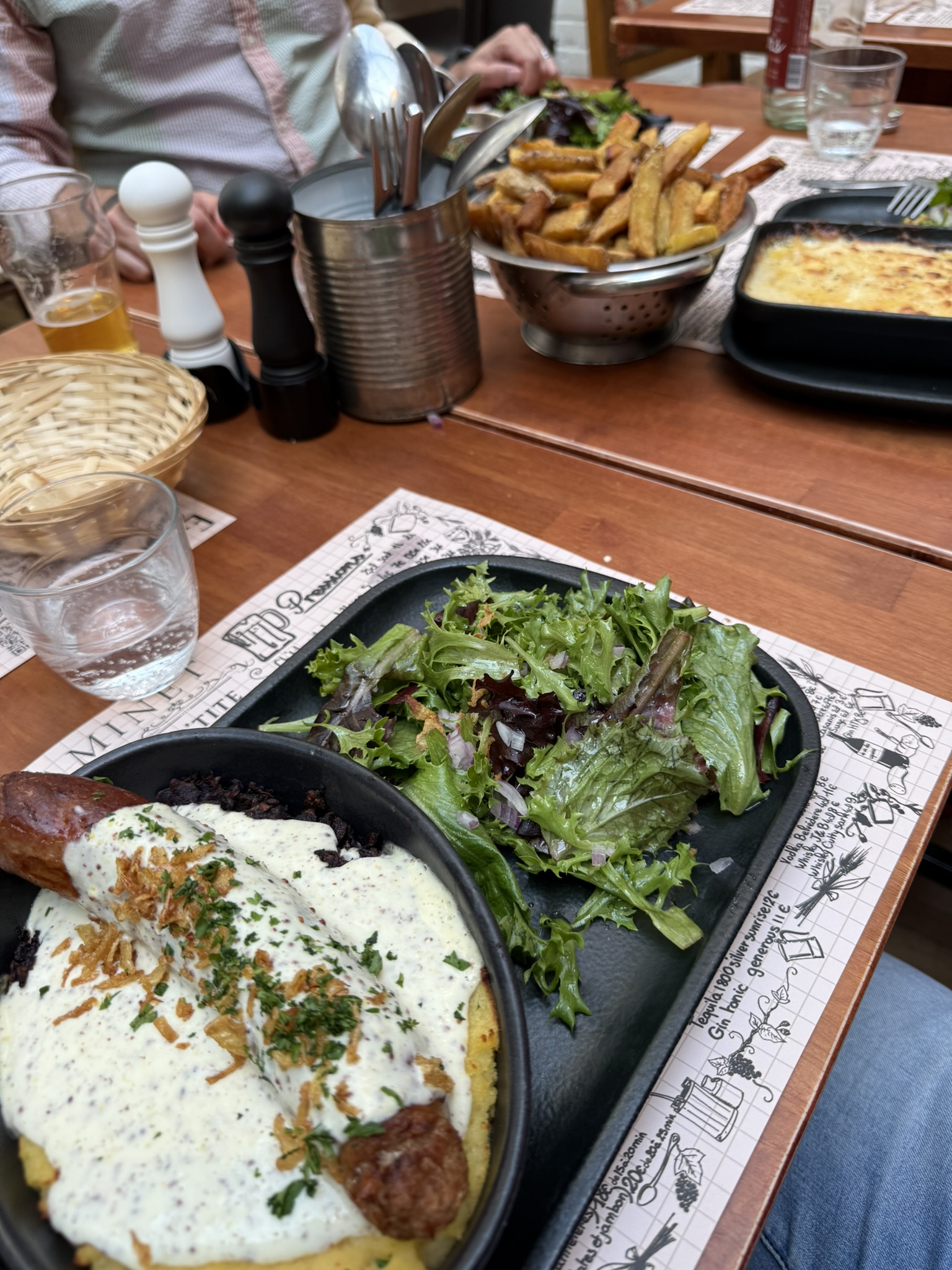
The Welsh fare in Lille

The Welsh fare in Lille

The view from my Airbnb in Brussels

The view from my Airbnb in Brussels

My Airbnb in Lille overlooking the park
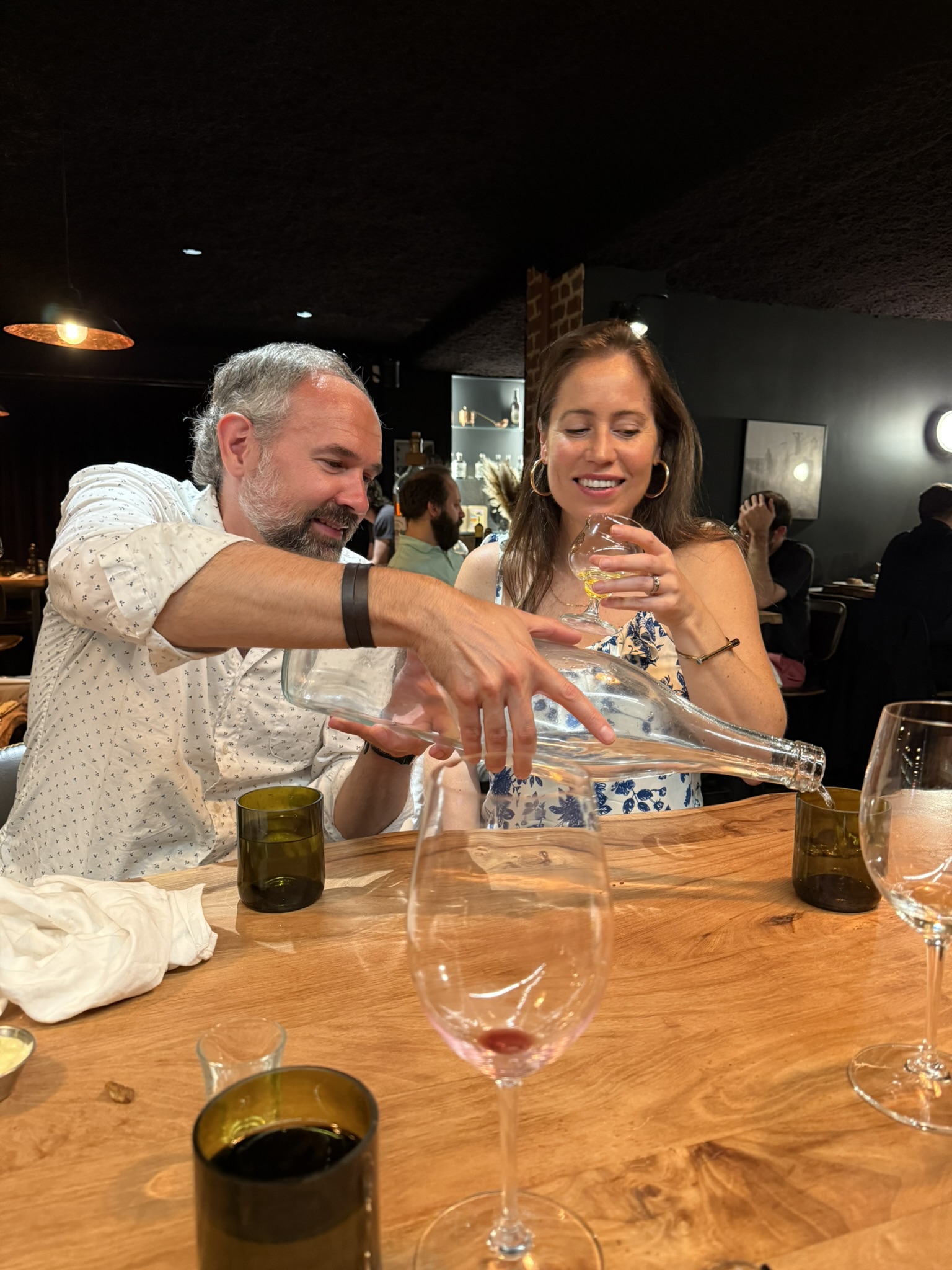
My Airbnb in Lille overlooking the park

My gracious hosts

My gracious hosts

The World War 1 Memorial in Belgium

The World War 1 Memorial in Belgium

Another shot of my Airbnb in Lille

Another shot of my Airbnb in Lille

One of the best Italian dishes I've ever had

One of the best Italian dishes I've ever had

A street in Lille

A street in Lille

Pickleball progress

My current goal is to get to 4.5 and my stretch goal is 5.0. Pickleball ratings are basically on a bell curve, meaning that marginal increases get harder and harder to achieve the higher you are on the scale. Getting from 4.0 to 4.5 is not easy but is significantly easier than 4.5 to 5.0. So any progress is meaningful.

I have been really grinding to improve my game. That means a lot of practice on my Pickleball Tutor, focusing on specific shots to improve weaknesses and gaps in my game. That work is paying off, but it’s slow progress.

Bottom line is that it’s just difficult for me to improve because I had no racket sport background before I started, and because of all the depth perception and light-contrast issues I’ve written about before. There is virtually no part of improving at pickleball that is natural or easy for me, so I just have to grind away to make small improvements.

Which is fine. As long as I’m improving, I’m good. At least twice this year, I played in a game with someone who hadn’t seen me play in a long time and they later said something like, “Whoa. He’s way better than he used to be.” That slowly opens doors for me to occasionally get into better games (as a backup to a backup or something), which will help me improve a little faster.

Third shots

One thing that was holding me back in 2024 was my third shot. I was just doing it wrong. Sometimes, it would be pretty good, and other times it would be really bad. So I had to break it down completely and rebuild it. That took … a while. I estimate that I hit 10,000+ third shot drops on the Tutor to get it grooved in.

Now it’s one of my best shots. It’s very reliable and I can use it as a way to manipulate point structure.

Other shots

My dinking has also gotten very good, especially on the left side. I can pretty much move the ball around wherever I want, often hitting a series of shots to set up a winner for me or my partner. That’s pretty cool.

My serve is my best shot and has been for a while, but other shots are starting to catch up.

I’m to the point where I’m just selecting one weakness at a time and working on it until it’s no longer a weakness. For example, I realized that my volley dinks weren’t great because I had never really worked on them. I got good at dinking because I drilled with a partner who is very good at pickleball and dinking. That’s good because I can handle aggressive dinks, and dink patterns that move me around a lot. But because he’s so good at dinking, he rarely gave me volley-able dinks to work with. I’m just used to having to let his dinks bounce because I would normally be reaching too far to volley them.

Well, the games I play often have many volley-able dinks. But since I hadn’t worked on that skill, I would just have to let them bounce anyway, which is a sort of double-whammy: I missed opportunities to volley and take control of the point and I was often back-footed because the ball traveled so far.

After five or so sessions on the Tutor, my volley dinks improved dramatically and are no longer a weakness. It’s a very subtle thing, but meaningful.

Now I’m working on resetting from the transition zone. That’s just a gap that I have never spent time on. Now that I’ve worked out some other weaknesses in my game, this is a glaring weakness that needs to be addressed.

Slow and steady.

Joining an advisory board for a startup

I wasn’t sure whether this would be considered “Personal” or “Business”, so I’m just putting it here.

A friend of mine has a seed-stage startup called Rovex and he asked me to join his advisory board, specifically to advise on business and negotiation strategy. This is cool because it’s a nice example of doing something for fun that turns into something more.

Since my friend had the idea to start the company, we’ve talked about the concept, execution, roadmap, all that stuff. And as he began hiring for key roles, he would loop me in to talk about which roles to focus on and how to think about compensation.

Obviously, my day job is helping candidates negotiate job offers that are extended by businesses. But this is a chance to flip that on its head and consult with a company on how to think about compensation for early-stage hires.

On its face, this might seem like a sort of conflict of interest, but my philosophy has always been that compensation done right is good for everyone—the candidates accepting the jobs, and the companies employing them. Candidates get paid what they’re worth, and companies get good candidates and have lower attrition rates in the long run.

For an early-stage company, incentive alignment is extremely important. That means sometimes coming up with creative compensation packages that align everyone’s incentives in a productive way.

This is just a natural extension of what I’ve been doing for a decade. Advising on the business side is really fun as well. It’s cool to have an indirect impact on what could eventually be a big tech company.

The Gator Basketball team is good again!

Almost exactly a decade after Billy Donovan moved to the NBA, Gator Basketball is finally good again! What Todd Golden has done in just three years is really remarkable. He had never even won a Tournament game before, and then he ripped off six straight to win the Natty.

His approach to coaching is extremely analytical, which I love, and he is excellent at developing players. It’s been a long, long time since I had anything good to say about Gator sports, so it’s nice to have another Title to celebrate.

2026 Goals

Ok, it’s time to look ahead to 2026. I’ll keep it pretty brief this year, I think.

Maintain or grow the business

I was pretty darn busy this year, and my business isn’t really designed to “scale” per se, so shooting for another 50% year-over-year growth year might be a little ambitious.

There is a path to growth, but that would be via two potential mechanisms:

  1. More clients. I was consistently busy and close to capacity for a good amount of the year, but not at capacity.
  2. Larger average deal size. This is sort of happening naturally, but working on bigger deals could bump revenue. I might be able to induce this to happen quicker, but I think it’s naturally happening on its own and I’m inclined to just let it happen organically.

Improve to 4.5 at pickleball

This is doable this year. I pretty much know what I need to improve to get there, and going from 4.25 to 4.5 is not a huge leap. I’ll be disappointed if I don’t hit this, and I think there’s a chance I exceed it by a little bit.

I suspect that somewhere around 5.0 is my ultimate ceiling, but we’ll see.

Write a manuscript

I have two book ideas that I’ve been knocking around. Both of them would be fun to write, but they are very, very different. So I just need to pick one and work on it. I think I’ve made that pick and started one manuscript a few months ago, but I’m not so deep into it that pivoting is off the table.

Find one new go-to dish to cook

Re-upping this from last year because I just didn’t get it done. I have actually set up a little learning plan with ChatGPT to teach myself the basics of cooking, so I just need to follow that plan.

I can make pretty good dishes, but they’re all just me executing a good recipe as opposed to me knowing how to cook. My plan with ChatGPT will make me a more competent cook.
What’s the deal with the SEC! chant?

Now that college football season is over, and FSU won the final BCS Championship, there’s a bit of a college football vacuum to fill. I might as well take a few minutes and explain something that seems to really confuse people outside the SEC: What’s the deal with the “S-E-C! S-E-C!” chant?

The short version

The SEC! chant was a marketing gimmick to get SEC teams more votes and more favorable rankings in the polls, meaning higher BCS rankings and more shots for SEC teams to win the BCS Championship.

The longer version

The BCS era was a transitional regime between simply voting for the national champion and deciding the championship “on the field” with a playoff. It was essentially a two-team playoff whose participants were determined by a computer algorithm that accounted for poll rankings, strength of schedule and some other stuff. The actual algorithm changed often throughout the BCS era as components were dropped, certain polls got more weight, the strength of schedule formula changed, and they made other tweaks here and there. But at its core, the BCS relied very heavily on polls, getting votes, and beating other BCS-ranked teams.

The SEC! chant reminds voters that the SEC is pretty good, so they’ll give SEC teams more votes, leading to higher poll rankings for SEC teams. This has an explicit benefit of nudging SEC teams ahead of non-SEC teams in the polls, and subsequently improving BCS rankings for SEC teams. For the last half of the BCS era, if it came down to a tight race between an SEC team and a non-SEC team in the polls, the SEC team would generally get preference. Sometimes, the preferred team would be a non-UF SEC team, but sometimes it would be UF, and we’d get a shot at a title. So that’s one way it helps UF when UF fans root for the SEC.

There was a nice indirect benefit, too: The BCS formula also included a bump for “quality wins”, so beating a Top 15 BCS team meant a better BCS score, which often meant a better BCS ranking. Most of a football team’s season is played against conference opponents, so if your conference had a lot of BCS-ranked teams, then that was good for your team because there were more “quality win” opportunities available. But if your team was the only BCS-ranked team in its conference, that meant there were no in-conference quality wins available. In this sense, rooting for the SEC was also rooting for UF.

To put a finer point on it, the SEC! chant gave SEC teams a small mathematical edge over non-SEC teams in the BCS formula; since UF is an SEC team, UF got a small piece of that edge. So, at least in the SEC, we could have our cake and eat it too—we could root for our team by rooting for our conference.

Coda

The trick with this whole gimmick is the SEC had to show up and actually win games so that the SEC! chant would continue to carry weight. If the SEC had gone to a couple BCS Championship games and lost, the chant would’ve been almost worthless. Of course, the SEC dominated the BCS era with the most appearances of any conference, winning three more BCS Championships than all other conferences combined. So it seems the SEC! chant served its purpose.

The Fair Weather Fan: A triumph of sports marketing

A Fair Weather Fan
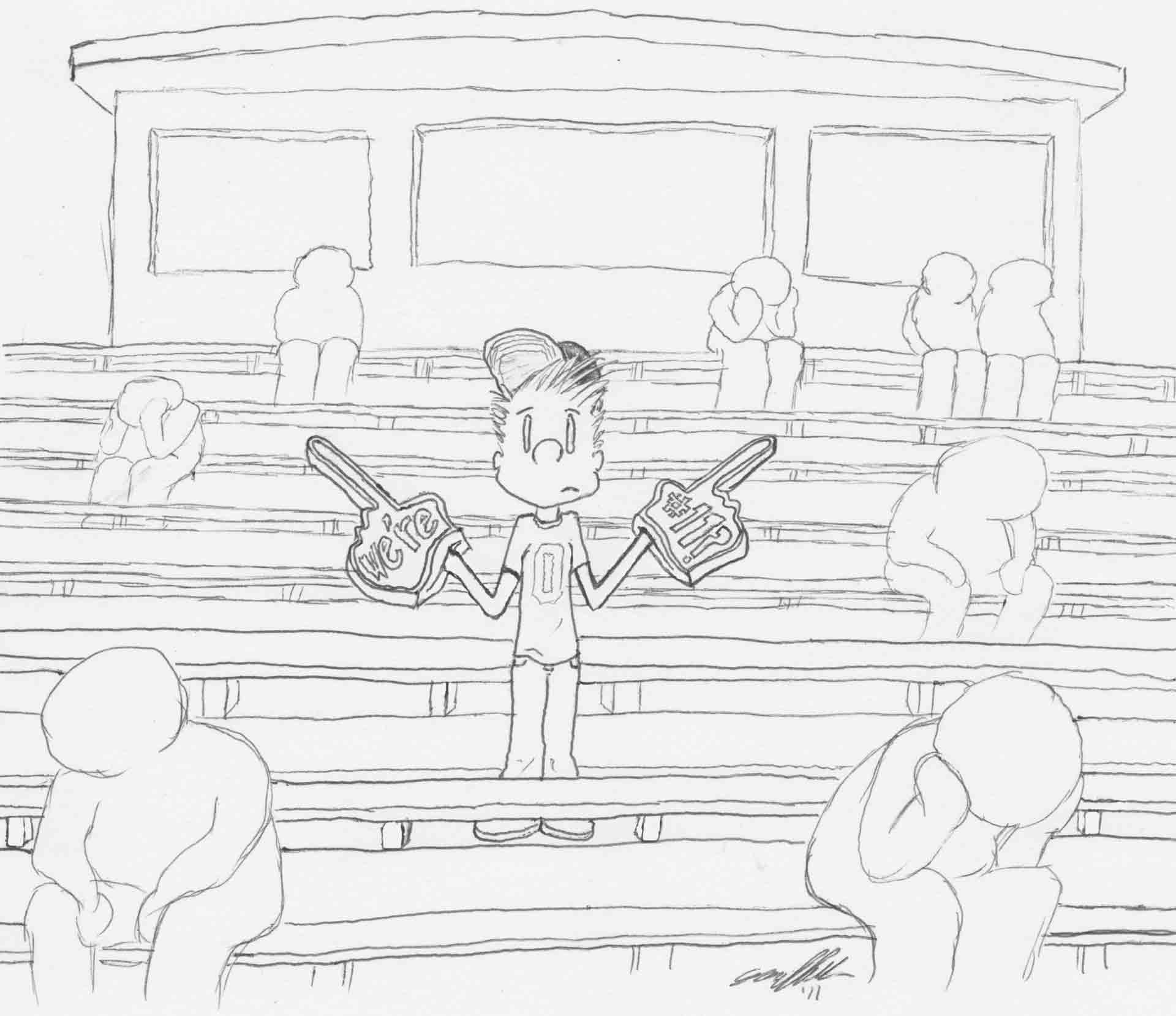
A Fair Weather Fan

Illustration by Sean Nyffeler *

Part of the American ethos is that we should love sports, and that we should love particular sports teams. This goes all the way to the top: George W. Bush recently threw out the first pitch at a World Series game, and next March will bring hours of coverage of President Obama’s bracket for March Madness.

A good way to get a funky look is to go to a Chili’s and tell someone you “don’t follow sports.” If you’re lucky, they’ll pity you. If you’re unlucky and they’ve had a few drinks or recently seen their favorite team lose, you could be berated and publicly mocked for your lack of culture or cojonés. If you’re really unlucky, you could be punched in the face or even forced to drink a generic light beer (it’s definitely possible that I’ve been watching too much of The League lately). Only slightly less repulsive than a sports non-follower is the agnostic sports fan. “Who’s your team?” “I don’t really have a team. I just like watching the games.” He probably won’t be berated or flogged, but he’ll almost certainly hear a guffaw or see a smirk.

But among the upper crust of American society, among Die Hard Sports Fans, the most reviled group of fans may be those of the fair weather variety. Not to be confused with bandwagon fans (although they’re not mutually exclusive), the Fair Weather Fan is one who ostensibly “has a team”, but who only roots for his team when it’s doing well. Not winning Super Bowls or World Series rings recently? Then the Fair Weather Fan is nowhere to be found. He’s not off rooting for some other team, he’s just not rooting for his team since they’re no good right now.

To some sports fans, being called a fair weather fan is one of the more flagrant offenses. “I’ve been rooting for this team since they were awful! My father lived and died without ever seeing us win a ring!” He wants you to know that he has suffered. He was there when they were awful. He went to the games. He’s witnessed heartbreak. Repeatedly.

Let’s step back and look at sports objectively, as a product. The not-best way to do this is to create a character who isn’t me, but is a lot like me and speaks in the first person. So I’m going to use this device for a little bit:

It’s Game Day. I go to the stadium, and I pony up $50 to see the game. I pay $5 for a hotdog. I pay $3 for some Gatorade. I pay $5 for some cotton candy because I have a sweet tooth and I can’t not eat sweets when I see them. Sue me, ok? If we win, I’m really happy that I spent $63. But we don’t win. We lose and I’m pissed that I just blew $63 on such a crummy game where I ended up with a nasty stomach ache.

Next week, we’re playing again. Yeah, I blew $63 last week on a loss and a stomach ache, but you know what? I’m going again because I’m a fan, ok? I put up another $50 for a ticket, and some more for concessions that most children could make with a dollar and some unsupervised time with a stove (No, not an Easy-Bake Oven. You can’t make authentic sports-stadium concessions in that. I’m talking about a real stove, manned by a real child.). We lose again. This one stings because I’m pretty sure some of the cheerleaders got playing time in the second half. I’m not even sure My Team is trying, ya’ dig? Now I’m out $120-something and I’m starting to get an ulcer from all the stress and bad food I’ve been eating. In a moment of clarity, I look at our record for the past two seasons: we have two wins. That doesn’t seem too good. I’m a big fan of My Team and everything, but two wins seems… maybe a little on the weak side?

Ok. We have another game in two weeks. I’ll need to work overtime and do a Miracle Cleanse to get ready for the game, but I can do it. I can get the money together and hopefully my gut will be back to normal by then. But you know what? I’ll be honest here: I’m having second thoughts about this one. I’m not sure I want to spend a bunch of money on a game we’re probably going to lose. I haven’t even talked about how I have to spend the whole day getting ready for the game, going to the game, getting home from the game. It’s a big investment, and I’m just not sure I want to make that investment again right now. Maybe if we were winning these games, but man we’re losing almost every game.

Why are you shouting at me? I think you just got some spit in my eye. You seem pretty worked up. Are you ok? What does that giant vein in your forehead mean? I’m just trying to explain what’s going through my head as I decide whether I want to go to this next game.

So that poor guy (who, like I said, isn’t me at all) just got chewed out for not being excited to pony up $60 to go see his favorite sports team lose again. That fella is dangerously close to sliding down the slippery slope that is Fair Weather Fandom, which is probably really miserable even when compared to the Island of Misfit Toys or the infamous Ugly Island.

Here’s the thing about fair weather fans: they may be much smarter than full-time, rain-or-shine, been-there-through-the-hard-times fans. You want efficiency? They are it. We’d never know that by listening to sports commentators or reading sports writers or talking to our other sports-fan friends. Still, it’s true.

Sports aren’t manna from Heaven. They aren’t a gift from God or Goodell. They’re products produced by businesses to make money. They’re products we buy. They’re products used to sell other products. We pay for them, we consume them.

Most of the time, we’re very discerning about how we spend our money. If we buy something and it sucks, we don’t buy it again. Or maybe we buy it just on more time to make sure it really was that bad. But that’s it. If it’s bad again, we’re done buying that thing. Unless it’s a ticket to a sporting event. In that case, we proudly buy our ticket and tell our friends that we were there through the lean times. It’s a badge of honor to tell stories about going to the games we were guaranteed to lose. “I went to every single game in 1975. We didn’t even have a quarterback that year, and our team’s contract stated they weren’t allowed to play more than one series in the second half!” That guy was really dedicated to wasting a bunch of time and money on something.

When fans decide their Favorite Sports Team sucks and they’re not going to keep spending money and time watching them suck, it isn’t the fans that are broken. The product is broken. It’s ok to make a rational decision to not waste money to go to games that probably won’t be any fun. That’s the smart thing to do. The more I think about it, the more I think that “Fair Weather Fan” isn’t a scarlet letter, it’s the mark of a rational, thinking person who has better things to do than dump money and time into a company that’s selling an inferior product.

So how did we get here? It’s one thing to point out that being a fair weather fan isn’t as stupid as we’ve made it out to be. But why do we hate fair weather fans? Because sports marketing is just that good. The entire sports industry (the same industry that brought you multi-day draft coverage, dedicated sports news networks, entire panels of people paid to discuss a “fantasy” version of a sport, and wall-to-wall coverage of player-versus-owner business negotiations) has successfully convinced us that we’re not buying a product. Sports are ethereal, a gift sent down from Mount Olympus to entertain man and make his life better. You don’t know who won the NBA Finals in 2005? That’s probably because you’re just not living a very satisfying and complete life. You’re working the full day on Monday? That’s only because your life is terrible and you haven’t found the wonderful world of Monday Night Football. What are you going to talk about on Tuesday? Your life or something? Your kids? That’s so lame, man!

Sure, you have to pay money to go see sports, but that money isn’t buying you a product, it’s buying you an experience. You get to hang with your friends, tailgate, drink yourself sideways, and tell stories the next Monday at work. Sure, there happens to be a team playing on the field, but that’s totally ancillary and almost coincidental. What you’re really buying is an experience, a collective opportunity to create a mass-memory that’s shared by you and everyone else who went to or watched that particular game. The irony, of course, is you could create your own memories for free. No, they wouldn’t be memories (fuzzy as they may be) of tailgating and football games, but they’d be a whole lot cheaper. And yet the geniuses (I’m not even being sarcastic there) who market sports to Americans have convinced us to pay for the privilege of creating memories with our friends, often at crummy sporting events.

Pretty clever, right? I’ve totally cracked the code!

Here’s the real kicker, though: I’ve watched all the Gator Football games this season. I watched some of them by myself at home. I just dropped $50 to go watch the Gators get killed by Alabama in The Swamp, and I might go to the Florida/Georgia game again this year. I’ve been to a lot of Florida sporting events. I’ve probably been to something like 60 football games, an SEC Championship game, some bowl games, dozens of Gator Basketball games, a Final Four and even some Florida baseball games. I don’t even like baseball. One year, I traveled back to Gainesville from Dallas just to watch the Gators in the Final Four with my friends… on TV! Why? I was making memories and stuff, but I also don’t want to be called a fair weather fan. I don’t really want to go watch us lose games when we’re bad (and we’re bad at football this year), but I don’t want to miss anything either. I’m fully aware that the idea of the Fair Weather Fan is totally manufactured and contrived, and yet I still don’t want to be called a fair weather fan. That’s totally nuts. The Fair Weather Fan really is a triumph of sports marketing; it transcends all reason and rationality.

But it is what it is, and I can’t wait for the Gator Basketball season to get started. You know we’re ranked Pre-season #10, right? We could be pretty good this year.

* Special thanks to Sean Nyffeler for his great illustration. You should read his stuff over at Popcorn Noises.

Need a story? Blame the refs!

Full disclosure: I’m a psychotic Florida Football fan. I spent almost six years as an undergrad at UF, and I’m there now working on my MBA. I may be biased. But so is everyone else who follows or reports on sports, so I’m not alone. In this article, I will try to be as objective and rational as possible, which means I won’t be trying to write this during any Gator games.

As always, the sports world has been awash in controversy and conspiracy theories this year. After all, who would watch ESPN if it were just a bunch of talking heads reporting scores that could be found freely on the web? Sports journalists’ jobs are to report facts and generate buzz. Buzz generates viewers. Viewers help generate revenue. And while I think that business model is fine, I think maybe sports journalists should be held to a higher standard than they currently are.

True, sports journalists aren’t typically reporting on significant world events — tragedies, politics, technological and medical breakthroughs, etc. — but, as with mainstream journalism, what they report can have real-world consequences. Usually, those consequences can be measured in dollars, and sometimes they can be measured in affected lives. But even without measuring the effects of what sports journalists report, I think it’s important that they report truth (or what they know to be true) and that they do their due diligence and find some evidence to support what they’re “reporting”.

Do Florida and Alabama get all the calls?

“There’s a conspiracy to get Florida and Alabama into the National Title game!” This statement has been made both explicitly and implicitly by many over the past several months. Mike Wilbon very, very strongly implied it. I think he stopped short of actually saying, “There’s a conspiracy theory.” when Tony asked him point-blank if that’s what he thought. Ultimately, Mike fell back on claiming there’s an “environment” that is cultivated that causes this stuff to happen. Other bloggers and sports media personalities have alluded to it as well. And, true, these people aren’t “journalists” per se, but they’re sort of the cyclists of the car-and-pedestrian world: they get all the privileges of being journalists, but don’t have to follow any of the rules.

The mostly commonly cited indicator of the alleged conspiracy is that Florida and Alabama “get all the calls” in order to give them an edge against their opponents. In other words, the refs are either blowing calls, or making the wrong calls in order to give Florida an edge. I have yet to see any real evidence to support this claim. And yet the claim itself could have some very real consequences for people. For example, the refs for the Arkansas vs. UF and LSU vs. UGA games were suspended after the LSU vs. UGA game. That means they didn’t get paid. And it means their reputations have taken a hit. And it means their careers as refs could be shortened substantially. After all, if they’re trying to rig games, they’re responsible for defrauding a LOT of people, and they’ll likely end up in jail like Tim Donaghy. So, they’ve given up quite a bit to get UF and Alabama into the BCS Championship game picture, haven’t they? And what have they gained by giving up all that? Nothing that I can think of. It seems like the only possible compensation they might’ve received for assuming all that risk is cash. But where’s the paper trail? In the end, I think the onus is on the conspiracy theorists to gather some kind of evidence to back up their claims. Without any evidence, it’s just speculation. And that’s not “reporting”, is it? Even sports journalists are responsible for following some kind of “good reporting standard”, aren’t they?

Statistics is 99% certain it knows the answer

Let’s take a look at some rudimentary analysis of the claim that Florida and Alabama “get all the calls” to help them win games.

It’s actually really easy to see who’s getting all the calls in the Florida and Alabama match-ups this season. I did some basic statistical analysis of the penalties called against Florida and Alabama relative to their respective opponents. I looked at total number of penalties called against, and total penalty yards assessed against each team. Here are the numbers (all of these are averages) through the end of the regular season:

UF: 6.5 penalties called against for 49.5 yards per game.

UF Opponents: 6.17 penalties called against for 50.17 yards per game.

Alabama: 5.25 penalties called against for 46.25 yards per game.

Alabama Opponents: 6.08 penalties called against for 51.33 yards per game.

So, on average UF is flagged .33 fewer times per game and is penalized .67 yards fewer per game. And, on average Alabama draws .83 fewer flags per game and is penalized 5.08 yards fewer per game.

It turns out that these differences are not statistically significant. Specifically, we I can say that I’m 99% confident that neither UF nor Alabama have fewer penalties and yards assessed per game than their respective opponents due to real world factors such as bias or skill.

I’ve been running the numbers for both teams every week since Week 6 of the season, and there has never been a statistically significant difference between either UF or Alabama and their respective opponents with respect to aggregate number of penalties and yards called against.

Ultimately, I think there are two factors at play here: first, the media feels compelled to generate stories; second, there is some observer bias and that is clouding the media’s judgment. I don’t think my first factor really needs any explanation. It’s pretty obvious that the media in general, and specifically the sports media, thrive on controversy, tragedy, intrigue, etc. They actively look for these types of stories and, occasionally, they manufacture them to keep viewers interested. But the second one isn’t explored very often. For example, after the Arkansas vs. UF game, there were many cries of conspiracy to get UF into the Championship game. But where were the cries when the refs blew four big calls in the Tennessee vs. UF game earlier in the year? That game was close all the way (at least on the scoreboard), and the refs called an excessive celebration penalty against Florida that they didn’t call in a similar situation against UT later, and they wrongly called intentional grounding against Florida and totally blew an obvious intentional grounding call against Tennessee later. But those plays are never mentioned when the conspiracy theories are being discussed. Only plays that support the theorists’ hypothesis are discussed.

Hurraz!

I’m pretty much speechless. We won another title, and I think Gator Nation is just trying to take it all in and enjoy the moment. We may never win another one, so now’s the time to enjoy it.

Go Gators!

In ATL for the Final Four

I’m up in Atlanta for the Final Four. Last year, I flew from Dallas to Gainesville to watch the games with my buddies. As soon as the tourney was over, I started pricing Final Four tickets for 2007 and making plans to get to ATL for the games. Being in Gainesville was awesome, but there’s nothing like actually being there.

So, I’m “there” and it’s awesome. Before the tourney, I had us as 50/50 to repeat (that seems conservative, but I thought it was pretty generous considering we were only 1/65 of the field). Now? I’d say we’re about 4-to-1 to repeat (and I feel that’s pretty conservative). We looked really good tonight, and we seem to be up for almost any challenge. Since we already beat OSU (yeah, they’re a different, more mature team now, but we’ve improved a lot too) by 26 in December, I feel pretty confident we can do it again.

Billy D. to UK? Not a chance.

Billy D. isn’t going anywhere. He’ll “think” about it for a few days, but then he’ll announce he’s happy in Gainesville and he’s enjoying being a part of such a promising program that is still growing. He’ll talk about how great it is for his family in Gainesville, and he’ll hint that it would be nice to have some better facilities for the team. He won’t turn down the contract extension this time, either.

UK essentially just canned a very, very good coach who has had a rough few years. Any coach can have a few bad years (we were out of the tourney after the first weekend five years in a row), and I think UK overreacted. Billy walks on water in Gainesville, and he’ll have a pass for several years, regardless of what happens. Why move to a town where expectations are so high and patience is so low? Most importantly, I think, why would Billy leave a dynasty that he is currently creating to try and revive a dying dynasty in Lexington?

One more game

I’ve been saying for a while that this team will go down as one of the best ever… but only if they repeat. This team has five thousand-point scorers, potentially something like six or seven future NBA players, three SEC championships, tons of school and NCAA records, two Final Four appearances and, so far, one Championship. If they get the win on Monday, they’ll be considered one of the best NCAA teams ever. I’m trying to enjoy every game I see because it’s going to be a long, long time before we see this kind of team with this kind of talent again.

I should mention that Chris Richard would probably be starting at 95% of the schools in the country. He’s been consistently improving this year and has really turned it on in the post-season. He’s included in the “…six or seven future NBA players…” I mentioned earlier. I don’t think he’ll be drafted, but I think he’ll be picked up by somebody, and he’ll be a solid contributor off the bench.

It’s great to be a Florida Gator.

Ten weeks later…

Remember that time when I said I was going to try and make a substantive post every two weeks? Me neither.

So, here’s what’s been up since my last post:

Well, obviously, we’re more than SEC Champs these days. Since we whooped up on OSU, we’ve become the first school to hold both the basketball and football National Titles in the same calendar year. I don’t have much to say about that except that it’s great to be a Florida Gator. Oh, and I feel we’re a strong favorite to repeat in basketball… and look out for us in football next year.

Speaking of next year’s football team, it looks like Urban Meyer is a recruiting genius. But we don’t have a chance next year because we’re losing so much on defense, right? I don’t think so. I think our defense was great this year because we had a lot of talent, but also because we were so well coached. I think after spring practice and our first couple games this fall, we’ll be back on track. Also, our schedule is much more favorable this year and our offense is going to put up some serious numbers. I think our coaches will have the defense ready (though maybe not quite as good as last year), and our offense is going to put up better numbers this year. I think this year’s offense will make last year’s look pretty timid.

Moving on, um… I’ve been reading a lot. I recently finished reading Tipping Point. It was excellent, and it helped me have a new perspective on causality. It was interesting to get a better picture of what can make things “tip”. Here’s the analogy that comes to mind for describing what a “tipping point” is: Paper burns at 451 degrees Fahrenheit; it doesn’t burn at 450 degrees (in theory, or whatever). It’s not that 450 degrees isn’t hot, but that 450 degrees isn’t hot enough to cause the paper to burn – to tip. At 450 degrees, the paper is just hot; at 451 degrees, everything is on fire. But there’s not much difference between the two numbers. That one degree is just enough, in addition to the previous 450 degrees, to make a bunch of stuff happen and finally catch the paper on fire. And so it is with social epidemics – things will often be going on as they always have, and then some small thing suddenly causes those things to become something bigger and much more obvious. The book basically tries to break down the individual factors that contribute to something reaching its tipping point.

I am currently reading Fast Food Nation, which is pretty boring, but educational. I guess I’m learning a lot about what goes on behind the scenes in the “food industry”. The book goes through a brief history of “fast food”, then goes into the specifics of where most of that food is produced, who produces it and how very evil the whole process and industry is. Ironically, I keep finding myself craving a good hamburger while I read it. That ain’t right.

I’ve had a good run playing poker online recently. I spent some time working on my cash game, had a really, really good run, then took a break when the law of averages roundhoused me in the face (but still ran at about 5BB/100 hands for about 5K hands). I jumped back into MTTs and recently had a pretty big score in a $30 tournament. There were 113 people and I took 2nd for $678. Normally, I’d be very pleased with that finish except I battled back from a 2-to-1 chip deficit to a 10-to-1 chip lead (over about 25 minutes of solid heads-up play)… but then I lost a coinflip (AKs vs. TT), a 70-30 (King high vs. QQ), then lost another coinflip (all-in on a QTx flop with two hearts – I had KJo, he had 8h7h and flushed the turn). By the time all that was over, the blinds were so high we were just gambling. I lost one more flip and that was it.

Anyway, I’ve been to Jacksonville several times over the past couple months and I’ve enjoyed being able to get home so easily. I’ve seen my family several times and I’ve spent time with some friends too. It’s nice to be able to head up to Jax whenever I want, and it’s especially nice that I don’t have to burn vacation time or like $500 a trip. As I think back on my time in Dallas, it really seems like it was just an extended internship or something. I never really felt “at home” there, and I was always in a “wait and see” mode. I knew I’d either move west to pursue acting, or I’d move back east to be near my friends and family. Texas was never really a long-term option, and I’m really glad I ended up back in Florida. It’s hard to describe the overall increase in my quality of life since I moved, but it’s pretty drastic.

I bought a digital piano a few weeks ago. It’s a Kurzweil PC88 and it’s in pretty great shape, especially considering it’s probably 10 years old. I have been surprised how much dexterity I still have, and it’s been fun playing “by ear” instead of just reading sheet music. I can tell my musical ear has definitely matured since I’ve been playing the guitar. It’s nice to be able to just sit down and play something that’s in my head (at least a slimmed-down, easy version). Hopefully I’ll stick with it and become pretty decent.

I think that’s about all I have for now. I’ll try to make it back before April.

Florida Gators: SEC Champs!

I’m still getting used to the idea that we’re playing for the National Championship in a few weeks. It seems as though we’ve been struggling since the second half at Auburn, and yet we’ve done nothing but win since that game. Here are my thoughts on our win over Arkansas in Atlanta last weekend:

  • We had our best offensive showing since LSU. Hopefully we’ve turned a corner and we can take advantage of OSU’s soft defense.
  • The final score didn’t really demonstrate how much we dominated Arkansas. We had four pass interference calls on our defense; two of them kept an Arkansas drive rolling and both of those were terrible calls. Both of those bad calls led to an Arkansas touchdown on the subsequent play. Half of their points were on plays that never should’ve happened.
  • Leak threw two interceptions, but I think both of those were due to Arkansas calling tricky coverage as opposed to Leak making bad decisions. All in all, he played a great game and made good decisions all night.
  • Our freshmen had a really big night, which is good news for us in the Championship game. If they show up in Glendale like they did in Atlanta, we’re going to be a very dangerous team
  • Meyer’s fake punt call was probably a “bad” play call, but I love it from a psychological perspective. Our team had lost momentum and we needed something to happen to change the tone of the game. That play was exactly what we needed and it was a very well designed play.
  • Wilbur is a fantastic punter and he had another good game on Saturday. It was nice to see him make some big plays to win the SEC Championship, help get us into the National Title game and start erasing the memory of the blocked punt at Auburn. It was also hilarious to see him mock Arkansas’ punter at the end of the game.

Now, I just have to see about getting tickets (game and plane) for Glendale. So far, it looks like the trip will cost about $2000 and I’m not sure I want to spend that much money. I’m also not sure I’ll forgive myself if I pass on the game and we win.

Road trips!

Road trip 1: Tonight, for the first time in about three years, I went running (outdoors and everything!). I’ve been doing various cardio exercises–ridin’ the bike, the crazy elliptical thing–for a few years, but I hadn’t gone for a run in a while. It was actually pretty relaxing and wasn’t as tough as I anticipated. I went about 3.3 miles in 30 minutes (nine-minute miles). That ain’t great and it ain’t awful. On the up-side, I did have to run a bit of a hill, so I’ll tell myself that slowed me down a bit.

Road trip 2: Tomorrow night, I’m heading to Atlanta to watch the Gators in the SEC Championship game. When I was a student, we pretty much expected to play for the SEC Title and we were always hoping to get into the National Championship game. Nowadays, playing for the SEC Title is a big deal and I want to be there if we win it. Also, it’s a pretty good excuse to go hang with my friends in Atlanta (I haven’t been since last Christmas). So, I’m leaving right after work tomorrow and I should get there around 10:00 tomorrow night. I’ll be heading back on Sunday afternoon.

Road trip 3: In honor of all the road-tripping, I picked up Jack Kerouac’s On the Road (audio book). I figure it’s just a bonus that Beatniks likely weren’t opposed to partaking of the acid from time to time (of course, that’s speculation based entirely on some stereotype I have for reasons I can’t recall).

Crazy week

About a month ago, I moved out here to work for a small software company. I no longer work for that software company… because we were acquired by a larger, public company. At first, I was a little nervous since I’m the new guy and the new guy is typically the first to go if there’s any kind of reduction in force. But, as I thought it over and spoke with my boss, I realized that I don’t have anything to worry about. First of all, the acquisition has been in the works for a few months, so they would’ve had to incur the cost of hiring me, moving me, etc., all while knowing they could let me go. Obviously, that wouldn’t make very much business sense and since I know the people I work for have a lot of business sense (they did just sell their company for a nice chunk of change, after all), I had to figure they wouldn’t make such a costly mistake. Also, a good friend of mine approached me about working there–I didn’t pursue the company so much as the company pursued me–and I couldn’t see my friend leading me to move out here, only to be canned a month later.

So, after a lot of thought and several excellent meals on my new company’s dime, I’m pretty sure I’m good to go. Really, the best thing is that I know have more career options since I now work for an 800-person company rather than a 40-person company. Before, the only vertical potential was basically my boss’ job, and I don’t think he’s going anywhere for a while. Now, there are several places I can go within the company, and I can probably get there relatively quickly since the company is growing very rapidly.

Florida Football winning, but battling silliness

It’s true that we’ve had some close wins against mediocre teams, and we’ve had some close wins against great teams. Our only loss was a close one to a good Auburn team on the road. I haven’t seen the strength of schedule numbers recently, but I’m guessing our schedule is one of the most difficult. So what I really don’t get is why USC is already being anointed as the one-loss team bound for the National Title game. They lost to an unranked Oregon State and they’ve only beaten two teams who were ranked at the time they played. True, if they win out, they will have played a pretty tough schedule, but they still don’t have to play a conference championship game, and they certainly won’t be playing any Top 5 teams in the next few weeks.

We’ve beaten two ranked teams (one Top 10) and our only loss is to a ranked team. We’ll also likely meet a Top 5 Arkansas in the SEC Championship Game. Another thing to consider is that the quality of opponent in the SEC is just better than that of the PAC-10. We’re a stronger conference, but because our teams play defense, we’re being called weak.

I just needed to get that off my chest. If we win out and don’t play for the title, I think we should offer to switch conferences with USC, Texas or some other “big” team for a season. That would be interesting.